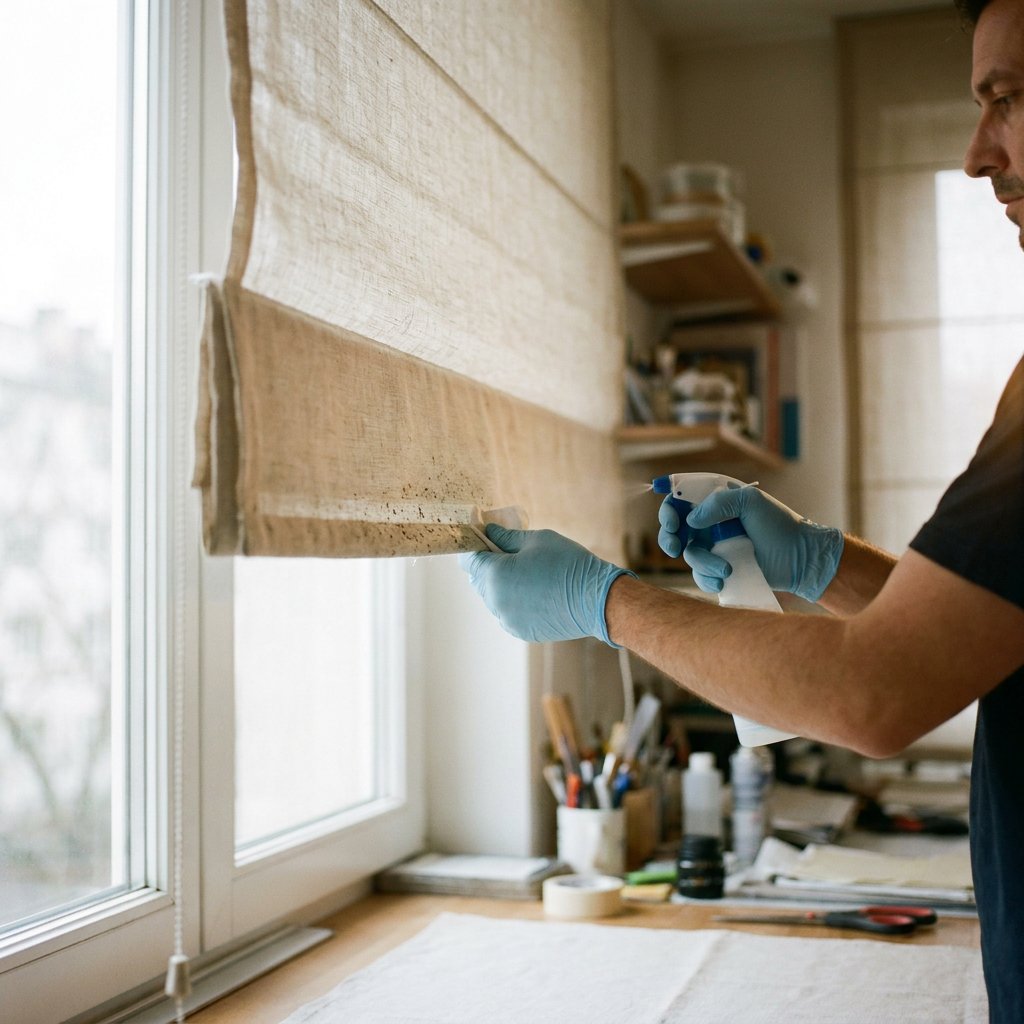
Mold on Roman shades needs careful treatment because the fabric, lining and stitching can all be damaged by aggressive cleaning. In most cases, the safest approach is to dry the shade fully, remove loose mold, test a mild cleaning solution on a hidden area and blot rather than scrub. If the fabric is delicate, badly stained or labeled dry clean only, professional cleaning is the safer option.
Roman shades often develop mold where condensation, poor ventilation or trapped moisture sit against the window side of the fabric. Acting early gives you the best chance of removing the growth without leaving permanent marks or weakening the material.
What to do before you start
Before cleaning mold off a Roman shade, check the care label or maker’s instructions. This matters because some fabrics and linings can tolerate light wet cleaning, while others should only be dry cleaned.
- Take the shade down if the affected area is more than a small surface spot.
- Work in a ventilated area, ideally outdoors or near open windows.
- Wear gloves and a mask if there is visible mold growth or dry powdery residue.
- Make sure the shade is dry first before vacuuming or brushing off loose mold.
- Patch test any cleaner on an unseen section to check for color loss or fabric damage.
If the mold covers a large area, has penetrated several layers, or the shade smells strongly musty after drying, DIY cleaning may not be enough.
How to clean mold from Roman shades step by step
1. Dry the shade completely
Do not start wet cleaning while the fabric is still damp. Drying first helps stop further growth and makes it easier to remove loose spores. Place the shade in moving air and speed up drying with a fan if needed.
2. Remove loose mold carefully
Use a vacuum with a HEPA filter if available, fitted with a soft brush attachment. Vacuum gently over the affected area to lift away dry surface growth. If you do not have a HEPA vacuum, use a soft brush very lightly and avoid flicking spores into the room.
3. Prepare a mild cleaning solution
For most washable or spot-cleanable Roman shades, use lukewarm water with a small amount of neutral pH detergent. Avoid harsh bleach-based products unless the fabric care instructions clearly allow them, as they can cause discoloration, weaken fibers and affect linings or trims.
4. Blot the moldy area
Dampen a clean white cloth with the solution and blot the stained area gently. Work from the outside of the mark toward the center so you do not spread it further. Do not soak the fabric, and do not scrub hard, as that can distort the weave or push the stain deeper.
5. Repeat only as needed
If the mark starts to lift, continue with light blotting using a clean section of cloth each time. Stubborn staining may need several passes, but the fabric should not become saturated.
6. Rinse lightly
Once the mold residue has been treated, blot the area again with a cloth dampened in clean water to remove detergent traces. Leaving residue behind can attract dirt and may affect the finish of the fabric.
7. Dry fast and fully
This is one of the most important steps. Dry the Roman shade as quickly as possible with good airflow. Do not rehang it until every layer is fully dry, including the lining and any stitched folds, because trapped moisture can cause mold to return.
If, after cleaning, any of the rings are stained or brittle and you plan to replace hardware during restringing, consider fitting new roman blind rings.
Can you use vinegar on moldy Roman shades?
Vinegar is often suggested for light mold cleaning, but it is not always the best choice for Roman shades. Some fabrics react poorly to acidic solutions, and vinegar may not fully remove heavier staining. If you use it at all, keep it for fabrics that are not delicate, test it first on a hidden section and use it sparingly rather than soaking the material.
In many cases, a neutral pH detergent is the lower-risk starting point for fabric shades.
What to avoid
- Bleach on unknown fabrics – this can leave pale marks and damage fibers.
- Heavy scrubbing – it can roughen the surface and spread the stain.
- Over-wetting the shade – moisture trapped in folds and linings encourages regrowth.
- Machine washing without clear care guidance – different types of Roman shades can lose shape or suffer damage to stitched construction.
- Rehanging while still damp – this is a common cause of mold returning.
When professional cleaning is the better option
Arrange professional cleaning if the Roman shade is labeled dry clean only, made from delicate fabric, heavily stained, or still marked after careful spot cleaning. Professional help is also sensible if mold has affected both face fabric and lining, or if you are dealing with repeated mold growth caused by condensation behind the shade.
Workrooms dealing with severe mold damage who choose to remake shades at scale may find our Roman shade production equipment cost and ROI guide helpful.
How to stop mold coming back
Cleaning the mark is only half the job. Roman shades usually develop mold because moisture is staying in the wrong place for too long.
- Improve ventilation in the room, especially in bathrooms, kitchens and other humid spaces.
- Reduce condensation on glazing where possible.
- Keep shades dry and do not leave them pressed against persistently wet windows.
- Clean dust regularly, since dust can help mold settle into fabric.
- Dry any damp areas quickly before mildew has time to spread.
If mold keeps appearing on Roman shades in the same setting, the root cause is usually environmental rather than cleaning-related. For more on preventing mold in Roman shades, it helps to address airflow and condensation as well as cleaning habits.
FAQ
How do you remove mold from shades safely?
Start by drying the shade fully, then remove loose mold with a HEPA vacuum or soft brush. After that, patch test a mild neutral pH cleaning solution and blot the affected area gently. Rinse lightly and dry the shade completely before rehanging it.
Can I just spray vinegar on mold and leave it?
That is not the safest method for Roman shades. Vinegar may affect some fabrics and leaving extra moisture in the material can make the problem worse. If used, it should be tested first, applied lightly and followed by proper drying.
What kills black mold immediately on Roman shades?
There is no one-size-fits-all instant treatment that is safe for every Roman shade fabric. Strong mold products may damage color, coatings or linings. For fabric shades, a cautious cleaning method that protects the material is usually better than using the strongest available chemical.
Will vinegar remove mold from blinds?
It can help with light surface mold on some blinds, but results vary by material and severity. On Roman shades, fabric sensitivity is the main concern, so test first and use a gentler fabric-safe approach if you are unsure.