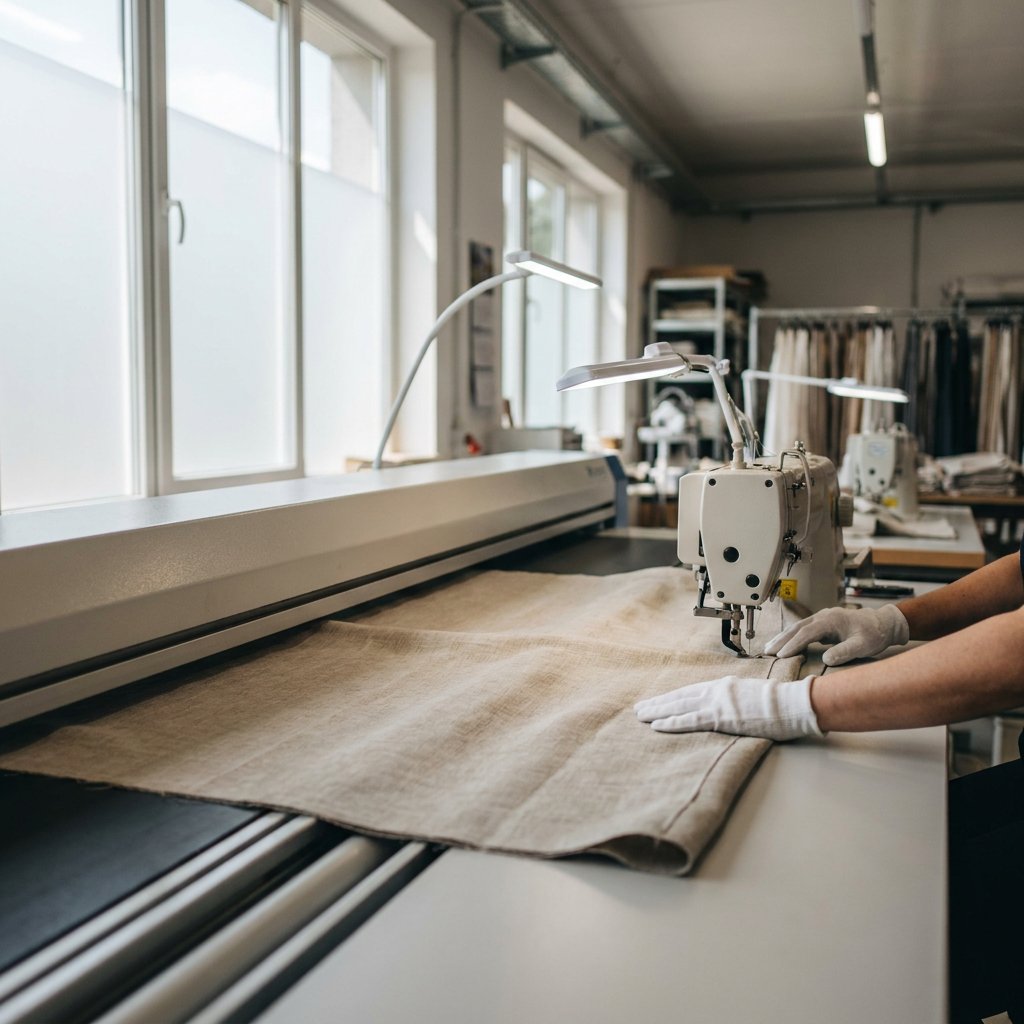
In industrial curtain production, edge finishing is where product quality becomes visible. Clean side hems, stable bottom hems and consistent stitch lines all depend on the right sewing method, controlled fabric handling and equipment built for repeatable output. For manufacturers, good curtain edge finishing industrial sewing is not only about appearance, but also about throughput, durability and reducing variation across every panel.
Industrial systems are especially valuable when fabrics are long, heavy or difficult to guide evenly. With the right sewing setup, manufacturers can produce accurate hems at scale while maintaining the finish expected in professional window covering production.
What curtain edge finishing involves in industrial sewing
Curtain edge finishing usually focuses on the side and bottom hems of the panel. In production, these operations need to deliver a straight edge, stable fold and consistent stitch formation across different curtain constructions.
The exact finish depends on the product requirement, but the core objectives stay the same:
- Accuracy – hems must remain even over the full length of the curtain
- Consistency – every panel should match the next without visible variation
- Fabric control – lightweight, slippery or heavy materials must feed smoothly
- Productivity – the process should support continuous industrial output
- Finish quality – the final edge must look clean and hold its shape in use
In practice, this means the sewing method is only one part of the result. Hem forming—for example with a hem prefolder—plus conveyor support and stable feeding are just as important when long panels must be processed efficiently.
Common stitch methods for curtain edge finishing
Different curtain programmes require different sewing methods. The most suitable option depends on the desired appearance of the hem, fabric behaviour and the production workflow.
Lockstitch
Lockstitch is widely used for visible, secure hemming. It is a strong choice when manufacturers need neat and repeatable side or bottom hems with a clearly defined stitch line. In conveyor-based curtain production, lockstitch supports stable sewing on long runs and can be paired with hemmers for single or double hems.
Blind stitch
Blind stitch is used when a less visible finish is preferred. This method is particularly relevant for bottom and side hems where appearance matters and the stitch should stay discreet from the face side of the curtain. In industrial production, blind stitching helps combine a refined finish with consistent output when the material is guided correctly.
Overlock stitch
Overlock stitch is relevant when edge security is a priority, especially where fraying needs to be controlled. In curtain production, it can support specific edge-finishing workflows and provide a clean sewn edge before or within the wider hemming process, depending on the construction required.
On extended edge seams, it’s also useful to troubleshoot issues such as top thread breaking in curtain sewing.
Why fabric handling matters as much as the sewing head
Long curtain panels are difficult to keep straight if they are guided manually alone. Even a suitable stitch type can produce poor results if the fabric twists, drags or feeds unevenly through the machine. That is why industrial curtain edge finishing often relies on conveyor support and guided feeding.
Controlled transport helps manufacturers maintain:
- Even seam alignment across long side hems
- Stable hem width from start to finish
- Reduced puckering on lightweight or sensitive fabrics
- Better handling of heavier materials on lower hems
- More repeatable output between operators and production runs
For factories aiming to improve efficiency, the advantage is not only stitch quality. Better fabric guidance also reduces rework, supports operator productivity and helps maintain rhythm in a continuous sewing line.
Key machine features that support consistent hem quality
When evaluating machinery for curtain edge finishing industrial sewing, the most valuable features are the ones that directly improve hem accuracy and process stability.
| Feature | Why it matters for edge finishing |
|---|---|
| Conveyor-supported sewing | Helps keep long curtain panels straight and supported during hemming |
| Interchangeable hemmers | Allows production of different hem constructions, including single and double hems |
| Blind stitch, lockstitch or overlock capability | Matches the sewing method to the required finish and fabric behaviour |
| Stable feeding | Improves consistency on both lightweight and heavier curtain fabrics |
| Industrial build for continuous use | Supports repeatable quality in higher-volume production environments |
These features matter because curtain hemming is repetitive but not forgiving. Minor feeding errors become visible over the length of the panel, especially on side hems. A well-matched industrial system helps control those variables before they become quality issues. Stitch quality further depends on correct thread balance—if you notice tunneling or wavy hems, learn how to adjust bobbin tension.
Examples of industrial solutions for curtain edge finishing
Eisenkolb offers industrial curtain sewing solutions used for side and bottom hemming. Confirmed examples include lockstitch, blind stitch and overlock solutions within conveyor-based production setups.
- CCP-2300 – a lockstitch conveyor drapery sewing machine for bottom and side hems, with interchangeable hemmers for single and double hems up to 120 mm
- BBC-3000 – a blind stitch sewing head within the Basic Conveyor line for hemming such as side and lower hems
- SBC-3000 – a single-needle lockstitch sewing head within the Basic Conveyor line for hemming such as side and lower hems
- ACP-2300 – an overlock-stitch conveyor curtain sewing machine
For manufacturers, the practical value lies in selecting the machine configuration that fits the required finish, the curtain construction and the expected production volume.
How to choose the right setup for your production
The best solution depends on the finish you need to produce repeatedly, not just on stitch preference alone. A good evaluation should focus on production reality.
- Required hem appearance – choose between visible lockstitch, more discreet blind stitch or overlock-based edge control
- Hem construction – confirm whether single or double hems are needed and at what width
- Fabric behaviour – consider how lightweight, flowing or heavier materials will feed over long lengths
- Production scale – assess whether the line must support continuous high-volume hemming
- Process consistency – prioritise guided transport and repeatable settings to limit operator variation
For many curtain manufacturers, edge finishing performance is best judged by the complete workflow: how the panel is supported, folded, sewn and moved through the line, rather than by sewing speed alone. Related finishing equipment for curtains and curtain sewing consumables can also influence the overall production result. For ongoing consistency and fewer quality deviations, follow a curtain sewing maintenance checklist.
FAQ
How do you finish curtain edges in industrial sewing?
Industrial curtain edge finishing is usually done with dedicated hemming equipment for side and bottom hems. Depending on the desired result, manufacturers may use lockstitch, blind stitch or overlock methods, often with conveyor support to keep long panels straight and consistent.
How do you sew the edge of a curtain accurately at scale?
Accuracy at scale depends on controlled feeding, stable hem formation and the right stitch method for the fabric and finish. Conveyor-based systems help support the full panel length, which reduces distortion and improves repeatability across production runs.
What is the best stitch for curtain edge finishing?
There is no single best stitch for every curtain. Lockstitch is commonly used for strong visible hems, blind stitch for a more discreet appearance, and overlock when edge security and fray control are important.
Why are conveyors useful in curtain hemming?
Conveyors support long and sometimes heavy curtain panels as they move through the sewing process. This improves seam alignment, helps maintain hem width and reduces handling-related variation that can affect finish quality.