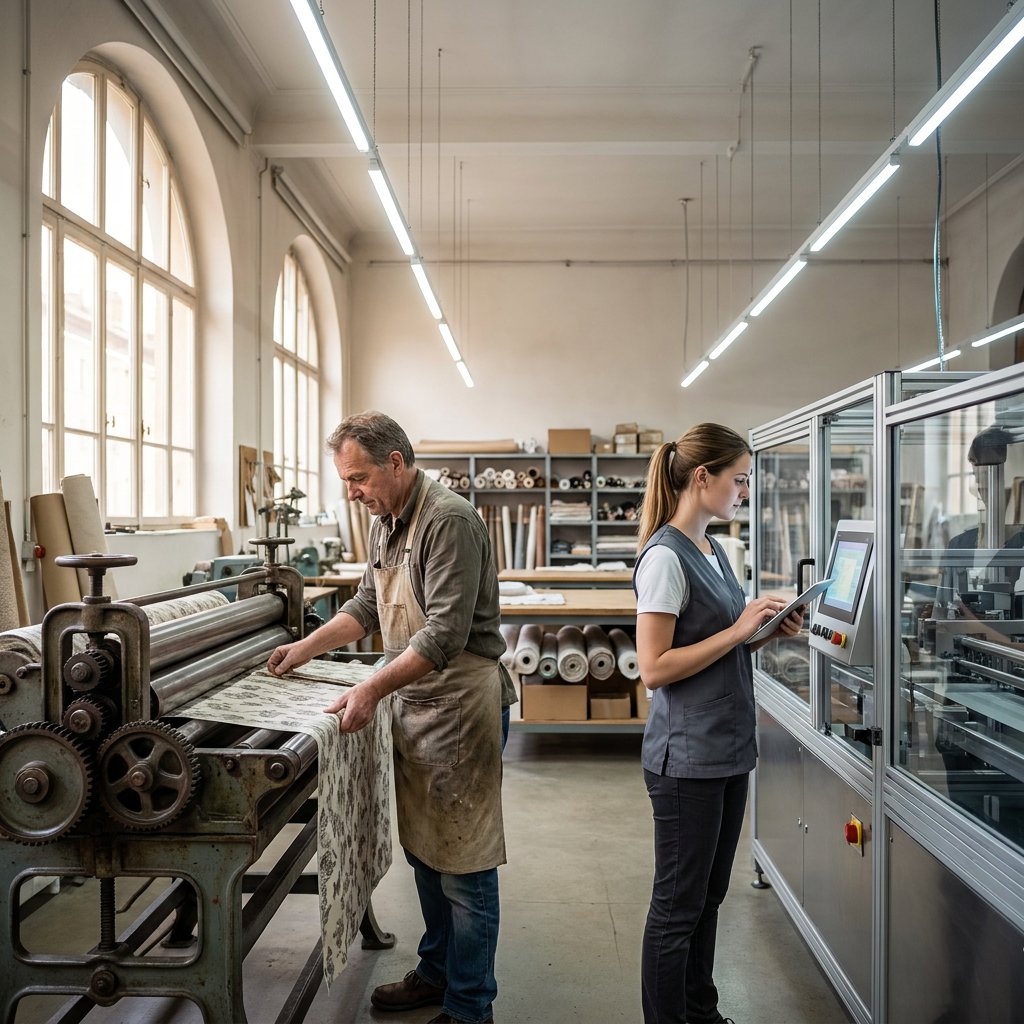
When a pleating line starts limiting output, consistency or flexibility, the real question is not simply whether the machine still runs. It is whether it still supports the production targets your business needs today. In many cases, manufacturers must weigh the value of keeping existing equipment against the benefits of moving to a newer pleating solution.
This comparison is designed to help curtain and window covering manufacturers make that decision with more clarity. It focuses on practical factors such as capacity, automation, quality consistency, downtime risk and long-term efficiency, so you can judge whether retrofit or replacement is the stronger investment.
What ‘retrofit’ means in a pleating environment
In this context, a retrofit means upgrading an existing pleating machine rather than replacing it completely. That can involve modernising controls, improving specific functions, replacing outdated components or adding features that improve usability, repeatability or productivity.
A new pleating machine, by contrast, is a full replacement. This usually means moving to a more current machine platform with updated automation, machine design and production capability.
The right choice depends on how far your current machine is from your operational needs. If the gap is small, an upgrade may be sufficient. If the gap is structural, a new machine is often the better long-term route.
When a retrofit can make sense
Retrofitting can be worth considering when the current machine still fits your production model and the core mechanics remain suitable for the work you do. This is typically most relevant when you need targeted improvement rather than a complete step change.
- Your current output is close to what you need and the main issue is reliability, control or ease of operation.
- Your pleat types and production flow are stable, so you are not asking the machine to do fundamentally different work.
- The machine frame and core construction are still sound, making further investment technically sensible.
- Downtime from full replacement would be difficult to absorb and a phased improvement path is more practical.
- Your budget is directed at selective improvements rather than complete line replacement.
In short, retrofit is usually strongest when the machine is still basically right for the job, but no longer as efficient or user-friendly as it should be.
When a new pleating machine is usually the better choice
A new machine becomes more attractive when the limits of the existing setup affect daily production performance in a deeper way. If the problem is not one weak component but the overall capability of the machine, replacement often delivers better value over time.
- You need more automation to reduce labour dependency and improve consistency.
- You want higher output and the current machine has become a bottleneck.
- You require broader pleating capability, such as moving from simpler production to more advanced or fully automated workflows.
- Quality variation is persistent and linked to the machine platform rather than operator adjustment alone.
- Maintenance demand is rising and spare-part or ageing issues are affecting uptime.
- You are planning long-term growth and need a machine platform that supports future production requirements more confidently.
For manufacturers aiming to scale, standardise quality and reduce manual intervention, a new pleating machine often creates a clearer path forward than extending the life of older equipment.
The key decision factors to compare
1. Production volume and bottlenecks
If your present pleating machine can still meet required volumes with acceptable uptime, retrofit may remain viable. But if orders, lead times or shift pressure show that the machine is regularly holding back throughput and labour savings with automated pleating, a newer platform may be needed.
This is especially important when production growth is expected. A machine that is already near its limit leaves little room for demand swings, planning efficiency or further automation.
2. Automation level
Automation is often the dividing line between upgrade and replacement. Some manufacturers only need to improve usability or control. Others need a more fundamental reduction in manual handling, repetitive operator tasks and quality variation.
Where the goal is a major automation step, a new machine is frequently the more realistic option. For example, Eisenkolb’s pleating machines include solutions from semi-automatic to fully automatic operation, including Microflex hook insertion, which reflects a broader move from manual dependence to integrated production efficiency.
3. Product quality and repeatability
Pleating accuracy affects not only visual finish, but also workflow stability. If operators need constant correction, or if output quality varies between runs, shifts or staff, the issue may go beyond maintenance.
A retrofit may improve control and reliability in some cases. However, if repeatability problems are tied to the age or limits of the machine concept itself, a new machine is often the more dependable solution.
4. Flexibility for your product mix
Some manufacturers produce a narrow, stable range. Others need more variation in pleat styles, order profiles or production settings. The more varied the production requirement, the more important machine flexibility becomes.
If the current machine still matches the range you produce, an upgrade may be enough. If your business has moved on and the machine has not, replacement may prevent continued compromise in setup time, workflow and output quality. If your primary styles include pinch or pencil pleats, compare pinch pleating machines for dedicated pinch workflows and pencil pleating machines to evaluate which models align best with your required throughput and finish.
5. Maintenance burden and lifecycle risk
Older machines can remain productive for many years, but rising maintenance effort changes the economics. Frequent stoppages, harder-to-source parts and recurring service needs all increase hidden cost.
At that point, the question is no longer the price of a repair or upgrade alone. It is whether continued investment in older equipment still protects uptime and profitability.
6. Total cost over time
The lowest immediate spend is not always the best business decision. Retrofit can reduce short-term capital outlay, but that advantage weakens if the machine still falls short on speed, labour efficiency, consistency or future readiness.
A new pleating machine usually requires a larger upfront investment, yet it may lower the long-term cost of production through stronger output, fewer interventions and better repeatability. The right comparison is therefore total operational impact, not purchase cost alone. For a broader perspective on equipment cost and ROI, long-term value should be assessed alongside initial spend.
Side-by-side comparison
| Decision area | Retrofit | New pleating machine |
|---|---|---|
| Initial investment | Usually lower upfront spend | Higher upfront investment |
| Speed of improvement | Can be effective for targeted issues | Best for broader performance improvement |
| Automation step | May be limited by existing machine platform | Stronger route for major automation gains |
| Capacity growth | Suitable if only modest gains are needed | Better if output requirements are increasing significantly |
| Quality consistency | Can improve control if the base machine is still suitable | Often best if inconsistency is structural |
| Future flexibility | Depends on the limits of the current machine | Usually stronger platform for long-term planning |
| Lifecycle risk | Older machine risks may remain | Lower legacy risk from ageing equipment |
How to decide more confidently
A practical decision usually starts with one question: is your current pleating machine underperforming because it needs improvement, or because it no longer fits the job?
If the machine still suits your production profile and only needs targeted modernisation, retrofit can be a sensible route. If your business needs higher automation, more dependable quality, stronger throughput or a better long-term platform, a new pleating machine is often the more effective investment.
For manufacturers comparing new pleating options, it helps to assess the decision against real production goals rather than against the condition of the old machine alone. Output targets, labour efficiency, consistency and scalability should lead the decision. It can also help to review when to upgrade your drapery machines before committing to replacement. If you want a retrofit assessment or guidance on selecting a new machine, speak with a specialist.
Eisenkolb supplies new pleating solutions for curtain production, including the EPS-2200, MPS-2600 and PPS-2300. These machines support different automation levels, from semi-automatic to fully automatic pleating with Microflex hook insertion, giving manufacturers a clearer route to improved efficiency and repeatable quality where replacement is the right step. Readers who want more background on how automatic curtain pleating machines work can explore the process in more detail.
FAQ
Is retrofit or replacement better for an older pleating machine?
It depends on whether the machine still matches your production needs. If the core machine is still suitable and only needs focused improvement, retrofit may be enough. If capacity, automation or consistency are falling behind your requirements, replacement is usually the better long-term choice.
How do I know if my pleating machine is a production bottleneck?
Common signs include repeated delays, excessive operator intervention, inconsistent pleat quality, increasing maintenance stops and limited ability to keep up with order volume. If these issues affect scheduling or profitability, the machine should be reviewed as a strategic constraint rather than a maintenance issue only.
Does a new pleating machine always deliver better return over time?
Not always, but it often does when the current machine has broader limitations. A new machine can improve throughput, repeatability and labour efficiency, which may outweigh the higher upfront investment. The most useful comparison is total production impact over time.
What should be compared before investing in a new pleating machine?
Focus on production volume, automation level, pleat quality consistency, flexibility for your product mix, maintenance burden and long-term operating efficiency. These factors give a more accurate picture than purchase price alone.